Acousto-Optics
Permanent staff: Mathieu Jeannin (CR-CNRS)
PhDs: Thomas Gérodou
The interaction between phonons and photons in solids is a well known resource for photonic devices, the most famous example being the free-space acousto-optic modulator. In this prototypical device, a standing acoustic wave is generated in a crystal by a piezoelectric transducer, creating a refractive grating in the material. An optical beam impinging on the grating at the Bragg angle is deflected and shifted in frequency by the acoustic wave frequency. This is at the heart of many other devices and application, be it for free-space, fibered, or integrated photonic devices: filters, shifters, isolators. It should however be noted that most of these devices operate in the visible or near-IR part of the electromagnetic spectrum. In the very rapidly evolving field of integrated mid-IR photonics, we aim at using the acousto-optic interaction to develop integrated optoelectronic devices.
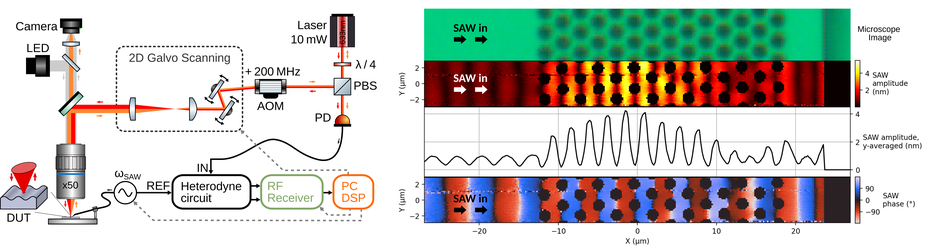
In order to characterize and optimize our acoustic devices, we built a galvo-scanning heterodyne laser vibrometer that allows to image the out-of-plane vibration of the sample surface, producing interferometric maps of amplitude and phase of the propagating acoustic field, in collaboration with D. Teyssieux [1].
A sketch of the setup and an example of an interferometric map is presented below, showing a Rayleigh wave propagating inside a photonic crystal structure.
Picture credits: T. Gérodou
References
[1] Teyssieux et al, “Absolute phase and amplitude mapping of Surface Acoustic Wave fields,” in 2013 Joint European Frequency and Time Forum & International Frequency Control Symposium (EFTF/IFC) (2013) doi: 10.1109/EFTF-IFC.2013.6702188
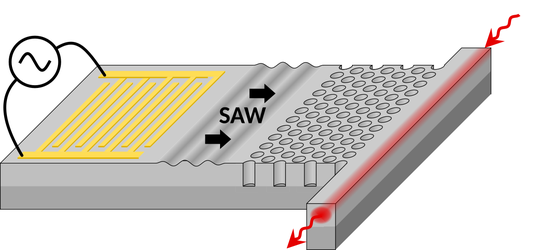
In the frame of the ANR Acousto-MIR project, we aim at demonstrating integrated acousto-optic phase modulators based on surface acoustic waves (SAWs). We leverage the unique combination of properties of GaAs/AlGaAs microstructures: as a piezoelectric material, GaAs allows the direct excitation of surface acoustic waves (SAWs) using interdigitated transducers (IDTs), and GaAs/AlGaAs heterostructures show broadband transparency in the long wave IR. The key to realize efficient AO interaction is to use microstructuration of the GaAs and AlGaAs layers to engineer at the same time the confinement of both optical and acoustic fields, creating effective photonic and phononic cavities or metamaterials with tailored properties.
Picture credit: T. Gérodou
This project is exciting and challenging as GaAs is only a weakly piezoelectric material, but its widespread use in mid-IR photonics and its role in other active devices (lasers, detectors, amplitude modulators) makes it extremely appealing as a monolithic acousto-optic platform. A successful demonstration of integrated AO phase modulation would open the way to integration of many other functionalities on the same material platform.
The goal of the project is to explore the amplification of surface acoustic waves coupled to a high mobility electron gas through the acoustoelectric effect, in view of developing non-linear integrated photonic-phononic circuits.
Acoustic wave devices are ubiquitous in modern electronics, serving as delay lines, filters, but also temperature, pressure or (bio)-chemical sensors. The most famous example is the surface acoustic wave (SAW) delay line based on a pair of interdigitated transducers (IDTs) on a piezoelectric material that converts an applied sinusoidal voltage in an elastic wave, as exemplified below.
The aim of this project is to explore novel opportunities when coupling acoustic waves to an electron gas through the acoustoelectric effect. A simplified device architecture is presented in Fig. 1. IDTs launch a surface wave on a piezoelectric material (here GaN). The acoustic wave propagates through an electron gas hosted in a mesa structure connected with DC leads, imposing a current and thus dragging the electrons. If the electrons and acoustic wave move in opposite direction, strong absorption of the acoustic wave is observed. However, when the electrons and the acoustic waves co-propagate with an electron drift velocity greater than the acoustic wave speed, amplification of the acoustic wave can occur.
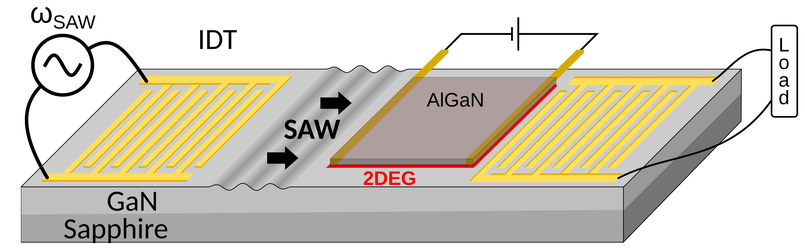
In this project, we would like to explore a well known material system combining piezoelectricity and relatively high mobility electron gas: AlGaN/GaN. This will enable additional functionalities, the first one being the ability to modulate the 2DEG electronic density using a gate. Using the transparency of GaN at near-IR and MIR wavelength we will then develop hybrid photonic-phononic integrated circuits leveraging acoustoelectric amplification to enhance the acousto-optic interaction on the micrometer scale.